
Knitting Gauge Guide: 3GG to 18GG for Custom Sweaters
Written by KnitSeek — the international B2B brand of Hangzhou Tongsheng Fashion Co., Ltd.
Last updated: September 18, 2026
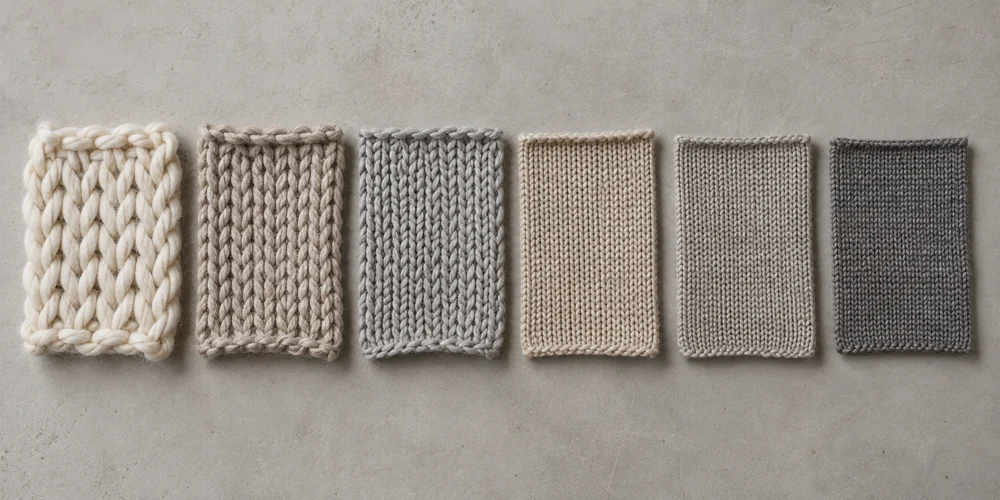
Scope of this guide: Industrial flat-knitted sweaters and knitwear. The gauge ranges below are practical development starting points, not fixed garment specifications. Yarn, stitch structure, machine setup, finishing, and the approved sample still determine the final result.
When a buyer asks for a 12GG sweater, the number describes the needle density of the knitting machine; it does not guarantee a particular garment weight, warmth, softness, or quality. SHIMA SEIKI defines machine gauge as the number of knitting needles per inch, with lower numbers producing coarser stitches and higher numbers producing finer stitches. STOLL uses the same needles-per-inch basis for its Gauge E system.
As a practical starting point, 3GG–5GG is commonly used for chunky and visibly textured knitwear, 7GG–10GG for mid-gauge products, and 12GG–18GG for finer, smoother knitwear. The final fabric can still change substantially with yarn count and ply, fiber, stitch structure, loop length, working needle selection, washing, and finishing.
Short answer: Choose the gauge together with the yarn and stitch structure. Use the gauge number to narrow the development direction, then approve a physical swatch and a finished sample before bulk production.
For a lightweight commercial sweater, 12GG to 14GG is often a practical development starting range, but it is not a fixed specification. A finer 16GG or 18GG machine may suit a very fine yarn and smooth fabric, while some lightweight designs can still be developed at 10GG or 12GG with a suitable yarn count, stitch structure and loop length. Choose the machine gauge together with the yarn and fabric construction, then approve a knitted swatch and finished garment sample before bulk production.
What Does GG Mean in Sweater Manufacturing?
GG is commonly used to describe the gauge of a flat-knitting machine. In a standard gauge system, it refers to the number of needles within one inch of the needle bed. A 3-gauge machine therefore has fewer, more widely spaced needles than a 12-gauge or 18-gauge machine.
This explains the general visual direction:
- Lower gauge numbers accommodate coarser yarns and create larger, more visible stitches.
- Higher gauge numbers use more closely spaced needles and are suited to finer yarns and smaller stitch detail.
- Mid gauges sit between those two directions and are widely used for commercial sweaters and cardigans.
The machine gauge should not be confused with the stitch gauge used in hand-knitting patterns. Nor should it be treated as the finished garment’s weight in grams per square metre. Machine gauge describes the needle arrangement; the finished fabric is the result of the complete yarn, structure, setting, and finishing combination.
Official definitions: SHIMA SEIKI glossary and STOLL artwork software documentation.
3GG to 18GG: A Practical Comparison
Use this table to prepare a first development brief. It is not a substitute for a swatch trial.
| Gauge direction | Typical visual result | Often considered for | Development points to approve |
|---|---|---|---|
| 3GG | Very large stitches, pronounced texture, substantial surface | Statement sweaters, oversized ribs, bold cables, heavy outer layers | Yarn bulk, seam weight, garment weight, drying behaviour, neckline support |
| 5GG | Chunky but more controlled than 3GG | Winter pullovers, cardigans, cables, structured ribs | Yarn ply, stitch definition, recovery, pocket and placket stability |
| 7GG–10GG | Medium stitch scale and versatile surface | Everyday sweaters, commercial seasonal programs, ribs, cables, jacquard | Target hand feel, stitch density, motif scale, finished measurements |
| 12GG | Fine, clean and commercially versatile | Merino or cashmere-blend sweaters, refined crewnecks, layering pieces | Yarn evenness, surface clarity, pilling expectations, dimensional stability |
| 14GG | Finer and smoother surface | Lightweight knitwear, close-fitting layers, refined cardigans and tops | Yarn compatibility, coverage, transparency, seam and edge finish |
| 16GG | Very fine stitch scale | Lightweight premium knits and compact smooth surfaces | Fine-yarn handling, stitch consistency, recovery, finishing control |
| 18GG | Finest direction within KnitSeek’s stated 3GG–18GG range | Ultra-fine layering knitwear and delicate, highly refined surfaces | Yarn availability, machine compatibility, opacity, snagging risk, care requirements |
Two garments made on the same nominal gauge can still look and feel different. The table should therefore be used to choose what to test, not to promise an exact finished weight or performance.
Why the Same Gauge Can Produce Different Sweaters
1. Yarn count and ply

Machine gauge limits the yarn sizes that can be knitted reliably, but it does not identify the yarn by itself. A compact, tightly twisted yarn can produce a cleaner surface than a lofty or brushed yarn on the same machine. Combining several ends changes bulk, coverage, cost, and yarn consumption.
2. Stitch structure

Plain jersey, rib, cable, jacquard, tuck, pointelle, and other structures do not use yarn or occupy space in the same way. A cable can make a fabric feel denser and more dimensional; an open pointelle can create airflow and transparency even when made on a relatively coarse machine. The same gauge number should not be expected to produce the same thickness across different structures.
3. Loop length and knitting density
Machine settings affect how much yarn forms each loop and how tightly the loops sit together. A more open setting may improve drape or transparency but can reduce coverage and stability. A tighter setting may give a compact surface but can also affect hand feel, recovery, and knitting performance.
Flat-knitting research treats yarn properties, stitch structure, loop length, and machine settings as interacting variables rather than isolated specifications. That is why a gauge number alone is not enough for reliable costing or approval.
4. Fiber and finishing
Wool, cotton, cashmere, acrylic, viscose, and blended yarns respond differently during knitting, washing, steaming, brushing, and wear. Finishing can change the surface, dimensions, softness, loft, and drape. Measurements and hand feel should be checked after the intended finishing process, not only on an unfinished panel.
5. Garment construction
The body structure may work well while the neckline, hem, placket, pocket, or linking method still needs adjustment. Chunky garments require particular attention to seam bulk and component weight. Fine-gauge garments require clean edges, consistent tension, and suitable handling to avoid distortion or snagging.
How to Choose a Gauge Before Sampling
1. Define the intended product, not just the gauge
Start with the season, silhouette, target customer, intended layer, and desired surface. “A lightweight office cardigan with a smooth finish” is a more useful brief than “a high-gauge cardigan.” “A chunky oversized cable sweater with visible stitch definition” gives the factory enough information to test a coarse-gauge direction.
2. Match the yarn direction to the product
Confirm the fiber composition, target hand feel, colour route, and whether stock yarn or custom-dyed yarn is expected. Ask the supplier to propose compatible yarn counts or ply combinations instead of forcing a yarn onto an unsuitable machine gauge.
3. Check the stitch and artwork scale
Large cables and bold ribs need enough stitch scale to remain visible. Small jacquard motifs, narrow stripes, and fine surface detail may require a finer gauge or revised artwork. Artwork should be reviewed on the intended machine and structure before the final size and placement are approved.
4. Compare physical swatches

When the direction is uncertain, compare two realistic options rather than approving from a digital rendering alone. Review appearance, hand feel, stretch, recovery, opacity, stitch definition, estimated yarn consumption, and compatibility with the design.
5. Approve the finished garment sample
The final decision should be based on a garment that has gone through the intended knitting, assembly, washing, drying, pressing, and measurement process. Keep the approved sample and confirmed specification as the production reference.
KnitSeek’s custom knitwear production process explains how design review, yarn selection, sampling, knitting, finishing, inspection, and packing fit together.
Gauge Selection Brief for Buyers
Send the following information when asking a factory to recommend a gauge:
| Briefing item | Information to provide | Why it matters |
|---|---|---|
| Product type | Crewneck, cardigan, dress, vest, knitted set, blanket, or other item | Construction and end use affect the practical gauge direction |
| Reference | Tech pack, sketch, original sample, or clear front/back/detail photos | Shows proportion, structure, and design intent |
| Season and market | Summer, transitional, winter; EU, US, UK, Australia, or another market | Helps define layering, hand feel, and care expectations |
| Yarn direction | Preferred fiber, blend, texture, or target hand feel | Gauge must be compatible with the selected yarn |
| Surface and structure | Jersey, rib, cable, jacquard, intarsia, pointelle, or mixed structure | Structure changes coverage, texture, stretch, and yarn use |
| Target result | Chunky, compact, soft, drapey, smooth, structured, opaque, or open | Gives the technician a result to develop toward |
| Fit and size range | Slim, regular, relaxed, oversized; intended size range | Garment dimensions affect weight and structural balance |
| Quantity | Units per style, colour, and size | Yarn planning and setup must suit the commercial order |
| Branding and trims | Labels, embroidery, buttons, zippers, patches, packaging | Components may need different support or construction |
| Testing and care | Market-specific testing, fibre content, care label, performance concerns | Requirements may influence yarn, structure, and finishing |
| Target date | Sample deadline and required delivery date | Development time and yarn availability affect the plan |
If the design is still at concept stage, KnitSeek’s custom knitwear service and design-your-own-sweater guide explain what can be prepared before requesting a quotation.
Common Gauge Selection Mistakes
Treating higher gauge as higher quality
An 18GG sweater is not automatically better than a 7GG sweater. Quality depends on whether the yarn, knitting, measurements, finishing, and workmanship meet the approved specification. Gauge describes a construction direction, not a quality grade.
Using gauge as a synonym for garment weight
A fine-gauge garment can be made compact or layered, while a coarse-gauge garment can use an open structure. Request an approved swatch, garment weight target where relevant, and finished sample instead of inferring weight from GG alone.
Selecting yarn and gauge separately
The factory needs to check whether the yarn size, ply, twist, strength, and surface are suitable for the intended machine and structure. An unsuitable combination can cause poor coverage, knitting difficulty, irregular loops, or a hand feel that misses the design target.
Approving an unfinished panel
Washing, steaming, brushing, and relaxation can change dimensions and surface appearance. Approval should reflect the intended finishing route.
Changing gauge without rebuilding the design
Moving a style from 7GG to 12GG is not a simple number change. Yarn, stitch counts, artwork, measurements, trims, machine program, and costing may all need to be revised.
Frequently Asked Questions
Is 12GG better than 7GG?
No. A 12GG machine produces a finer stitch scale than a 7GG machine, but the better choice depends on the design. A chunky cable or heavy rib may be better suited to 7GG, while a smooth layering sweater may be better suited to 12GG. Quality must be judged against the approved yarn, construction, measurements, and finish.
Is an 18GG sweater always lighter than a 12GG sweater?
Not necessarily. An 18GG sweater usually starts from a finer-yarn direction, but garment weight also depends on yarn composition and ply, stitch structure, density, dimensions, and added components. Compare finished samples rather than relying on the gauge number alone.
Which gauge is suitable for a summer sweater?
Fine gauges such as 14GG–18GG are common starting points for smooth, lightweight layering pieces. They are not the only option: a lower-gauge open pointelle or mesh structure can also create airflow. Fiber, coverage, garment shape, and the target climate should be considered together.
Can the same sweater design be made in several gauges?
Often yes, but each version requires redevelopment. The factory may need to change the yarn, stitch count, artwork scale, measurements, machine program, and finishing process. The resulting garments should be treated as separate samples, not assumed to be identical versions.
What should I send if I do not know the correct gauge?
Send the tech pack or reference images, desired composition or hand feel, season, fit, quantity, target market, colourways, price position, and required delivery date. A factory can then propose one or more yarn-and-gauge directions for swatching.
Should the gauge be confirmed before quotation?
A provisional gauge is useful for the first quotation because it affects yarn planning, machine setup, knitting time, and consumption. The final specification should be confirmed after the yarn and structure have been tested and the sample has been approved. If the development direction changes, the quotation may also need to be updated.
Looking for a Custom Knitwear Manufacturer in China?
Choose a supplier that can explain the relationship between yarn, gauge, structure, finishing, and costing instead of recommending a gauge from a product photo alone. Ask for a physical swatch or sample, confirm the finished measurements and hand feel, and keep the approved specification as the production reference.
KnitSeek is the international B2B brand operated by Hangzhou Tongsheng Fashion Co., Ltd. We support custom sweaters and knitwear across a stated 3GG–18GG range using Stoll, Shima Seiki, and Cixing flat-knitting equipment. Buyers can provide a tech pack, reference sample, sketch, or product images for review. Contact KnitSeek to discuss the yarn, gauge, structure, MOQ, sampling plan, and delivery requirements for your project.
References
- SHIMA SEIKI Mfg., Ltd. Glossary: Gauge and Fine Gauge. Accessed September 18, 2026.
- STOLL. Selecting the Size of the Artwork. The documentation defines gauges in needles per inch. Accessed September 18, 2026.
- Fouda, A. Knitting Force Measurement on Flat Knitting Machines. Journal of Textiles, 2014. The study examines relationships among yarn properties, stitch structures, loop length, and machine settings.