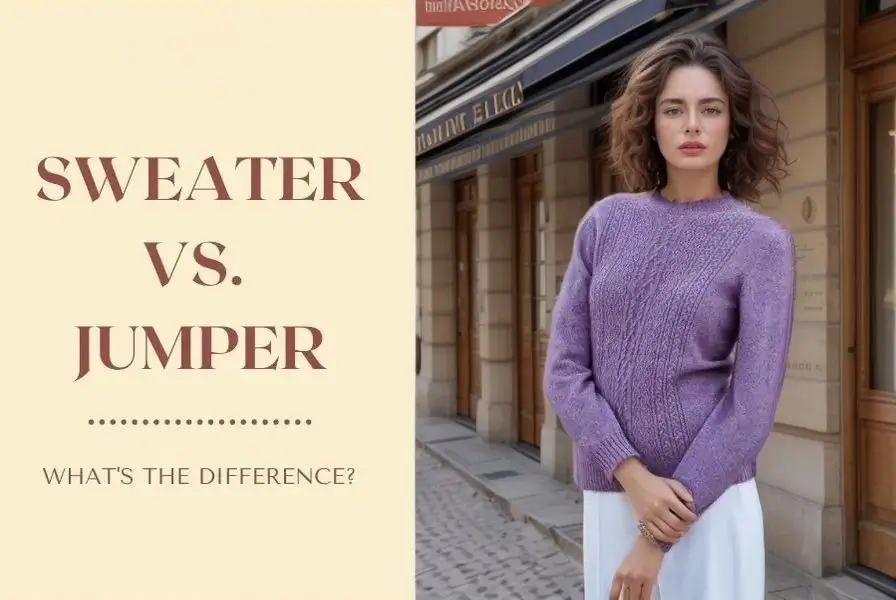
The main types of sweaters include pullovers, cardigans and sweater vests. Names such as cropped, oversized, raglan, cable-knit and quarter-zip describe additional features: length, fit, sleeve construction, surface or opening. They are not competing categories. One sweater can be a cropped, relaxed-fit raglan pullover with a cable pattern.
For a knitwear collection, the useful question is which part of the design each name describes. A clear style name helps a supplier understand the direction; front and back references, dimensions and construction notes make that direction specific enough to develop.
A quick index of sweater names and shapes
Start with how the garment is worn and opened. Knit Picks’ sweater anatomy guide includes both pullovers and cardigans under the sweater umbrella, then treats shoulders, sleeves, body shaping and length separately. That is a useful way to read a reference without mistaking every design feature for a separate garment.
| Name | Recognition cue | Detail still needed in the brief |
|---|---|---|
| Pullover | Put on over the head; the front does not open all the way to the hem. | Neck opening, any short placket or zipper, and intended body shape. |
| Cardigan | A front opening runs down the body. It may have buttons, a zipper or an open front. | Closure, front overlap, neckline and whether it should be worn open or closed. |
| Sweater vest | A sleeveless knitted top, with either a pullover or an opening front. | Armhole depth and the layer, if any, expected underneath. |
| Cropped sweater | A deliberately shortened body, often ending around or above the waist. | Finished body length and where the hem should sit on the intended wearer. |
| Tunic or longline sweater | A body extending below the usual hip-length proportion; the terms can overlap. | Actual length, hem width and side-slit details rather than a name alone. |
| Oversized sweater | An intentionally roomy silhouette. | Where the extra room belongs: chest, shoulder, upper sleeve, body length or a combination. |
| Raglan sweater | Diagonal sleeve-to-body lines run from the neckline toward the underarm. | Yoke depth, sleeve width and the intended shape; the name does not settle fit. |
| Cable-knit sweater | Raised crossed-stitch patterns create rope-like or braided textures. | Cable layout, repeat size and placement on the front, back and sleeves. |
A crew neck, V-neck or turtleneck adds another attribute to these descriptions. Keep the garment form and neckline separate in the style name: “V-neck cardigan” or “cropped crew-neck pullover” is clearer than “V-neck style.” For collar shapes and opening details, use the separate sweater neckline guide.
Sweater sleeve types also describe the shoulder
A long sleeve can be set-in, raglan, drop-shoulder or dolman. Sleeve length tells you where the cuff ends; shoulder construction tells you how the upper sleeve meets the body. Looking only at the cuff misses much of the silhouette.

- Set-in: the sleeve joins a shaped armhole around the shoulder. Look for a curved joining line around the upper arm, rather than a diagonal line reaching the neck.
- Raglan: the sleeve extends toward the neckline, creating the characteristic diagonal lines. It can be made through different construction routes, so the appearance does not prove that the garment is seamless.
- Drop shoulder: the sleeve-to-body join sits beyond the natural shoulder point. How far it drops, and how wide the upper sleeve is, affect the result; “drop shoulder” does not specify either dimension.
- Dolman: a broad underarm area flows into a sleeve that usually narrows toward the wrist. Check the underarm silhouette from both front and back, especially when the garment is shown with the arms raised.
A saddle shoulder adds a strip across the top of the shoulder. A circular yoke organizes the upper body around a rounded yoke rather than four distinct raglan lines. These names can help identify a reference, but a photograph may not reveal every joining or shaping detail. Use a close view before assigning a construction method.
For a brand briefing a raglan style, identifying the diagonal line is only the start. The existing raglan sweater fit guide explains why yoke depth, underarm width and chest ease need separate attention.
Separate body length from ease
Cropped describes a short body; oversized describes intended room. A cropped sweater can therefore be oversized, and a long sweater can fit close to the body. “Boxy” usually suggests a relatively straight, broad outline, but it still leaves the actual width and length unresolved.
What are long sweaters called? A long pullover may be described as a tunic sweater or longline pullover. If it opens down the front, “long cardigan” is usually more useful. Retail names vary, and a tunic-length top and sweater dress can overlap visually. State whether the garment is intended as a top over trousers or as a dress, then specify its length and coverage.
There is no need to impose a universal centimeter boundary on these names. A reference model’s height, posture and trousers can change how short a hem appears. Ask for the reference garment’s size and dimensions where available, and define the body-length measurement points in your own brief.
Ease is the difference between body and garment measurements at a specified location. “Make it oversized” leaves the supplier to decide where to add room. A better brief identifies the intended customer, base size and silhouette, then refers to a sweater size chart with defined measurements and grading. It also distinguishes a roomy chest from a dropped shoulder or a deep armhole.
Zip sweaters: check where the opening ends
The most useful first distinction among sweater types with zippers is a full opening versus a partial opening. A full-zip style opens down to the hem. A quarter-zip or half-zip pullover has a shorter opening and an intact lower front, so it is still pulled over the head.

Quarter-zip and half-zip are useful shopping terms, but they do not supply a production dimension. Show the intended lower end on the front sketch, give the finished opening length and describe the collar both zipped and unzipped. If a reference is photographed open, include a closed view as well.
Do not let the fastening replace the rest of the description. A full-zip knitted cardigan and a partial-zip pullover may share the same yarn and rib texture while needing different front construction. Confirm the trim, attachment and finished appearance during development rather than assuming them from the label “zip sweater.”
Pattern names describe the surface
Common types of sweater patterns include rib, cable, stripes and knitted color motifs. These terms describe different things: rib and cable refer to stitch structure; stripes describe color arrangement. A diamond motif describes a shape, but the shape alone does not identify the knitting technique.

Rib shows alternating face and back stitch columns and is often visible at hems, cuffs and neckbands as well as across a whole body. Cable creates crossed groups of stitches. Stripes may be narrow, broad or irregularly spaced. For any of these, a close photograph should show the repeat and where it stops or changes.
Colorwork needs a reverse view too. CottonWorks’ guide to single and double knits shows how single-knit Jacquard can carry floats on the back, while double-knit Jacquard can incorporate the unused yarn into a knitted backing. A similar-looking face therefore does not tell you the complete construction.
Keep the artwork request separate from assumptions about weight, stretch, warmth or cost. Record which panels carry the pattern and whether it continues across joins. If your reference only shows the front, mark the back and sleeves as decisions to resolve. For broader fabric and yarn distinctions, see knitwear structures and materials.
Turn a style reference into a usable brief
A style name is a short description, not a complete tech pack. Techpacker’s garment spec-sheet guidance recommends front and back sketches, additional detail views where needed, measurements and construction notes. Those views help distinguish the features to preserve from incidental styling in the photograph.
For the green pullover pictured above, a useful brief might begin with the following example. The dimensions are invented design targets to illustrate clear instructions; they are not measurements taken from the image, industry standards or a KnitSeek size specification.
Illustrative style direction: cropped, relaxed-fit crew-neck pullover with raglan sleeves, a plain knitted body and ribbed neckband, cuffs and hem. Preserve the short body and diagonal shoulder lines. Treat the photograph as a silhouette reference; choose yarn, color and gauge separately during development.
| Attribute | Illustrative instruction | What still needs agreement |
|---|---|---|
| Form | Pullover with a continuous front and crew neckline. | Neck-opening dimensions, rib depth and wearing position. |
| Cropped length | Base size M: target 48 cm from the high shoulder point at the neck join to the bottom hem, including rib. | Mark those endpoints on the sketch and confirm coverage on the intended wearer. |
| Relaxed width | Illustrative half-chest target: 54 cm, measured flat straight across at the underarm. | Target body measurements and the resulting ease; “M” alone does not define the customer. |
| Raglan sleeves | Retain diagonal lines from neckline to underarm and a gently narrowed cuff. | Yoke depth, upper-sleeve width and a construction-specific sleeve-length diagram. |
| Surface and trim | Plain body; rib neckband, cuffs and hem. No cable or color motif. | Yarn specification, gauge, rib dimensions, hand feel and sample appearance. |
| Measurement state | Measure the finished sample flat, relaxed and without pulling it wider. | Finishing/conditioning procedure, care checks, POM tolerances and the approved revision. |
This example deliberately stops short of a production specification. It still needs the complete measurement chart, size range, yarn and trim choices, tolerances and sample approval. Adding those decisions is more useful than adding more adjectives to the style name.
When several references are involved, explain their roles: one for body proportion, another for texture, another for a collar detail. Include front and back views plus the sleeve join, opening and hem where those details matter. A supplier should not have to guess whether you want the reference’s color, its silhouette or both.
Frequently asked questions
How many types of sweaters are there?
There is no single fixed count. Lists often mix garment forms, necklines, sleeve shapes, lengths, materials and patterns. A more useful system starts with the form—such as pullover, cardigan or vest—and adds the attributes needed to describe that design.
What is a long open sweater called?
“Long open-front cardigan” is a clear description when the garment opens down the front and has no fastening. “Duster cardigan” is also used for some long styles, but the name does not establish a fixed length. Include the finished body length and intended hem position.
Is an oversized sweater just a larger size?
Not necessarily. A deliberately oversized design can add room in selected areas while keeping the neck, cuffs or length controlled. Simply increasing the size may alter all of those areas. Define the intended silhouette and review the base-size sample before grading.
Can a raglan sweater also be cable-knit or cropped?
Yes. Raglan identifies the sleeve and shoulder arrangement, cable-knit describes the surface, and cropped describes body length. Combining those terms is useful as long as each is backed by a reference or specification detail.
Discuss the style before requesting production
When choosing a knitwear manufacturer in China, ask how the proposed yarn, gauge and construction will reproduce the reference’s shape, rather than requesting a quote from its style name alone. KnitSeek’s custom knitwear service includes design and tech-pack review, yarn sourcing, sampling, fit development and production planning, with the final scope confirmed for each project. Send the style references, intended quantity, size range, material preference, target market and delivery window; identify any details that are still open. You can discuss your sweater reference with KnitSeek to review feasibility, the sample route and quotation requirements.
References
- Knit Picks, Anatomy of a Sweater, January 29, 2020. Sweater forms, shoulders, sleeves, shaping and length terminology; handknitting examples are not universal industrial specifications.
- Cotton Incorporated / CottonWorks, Single & Double Knits. Rib structure and examples of single- and double-knit Jacquard.
- Techpacker, What is a Garment Spec Sheet and How to Add one in a Tech Pack, December 26, 2023. Reference views, measurements and construction notes; its woven-garment example values are not adopted here.
Sources checked October 21, 2026.